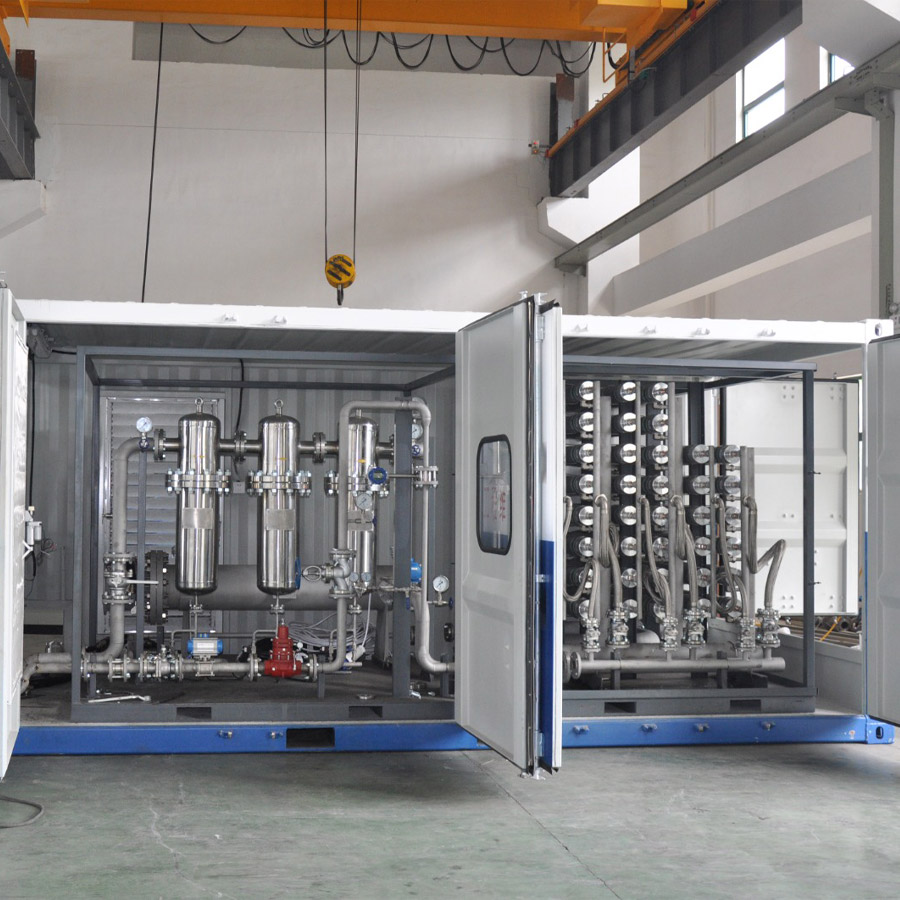
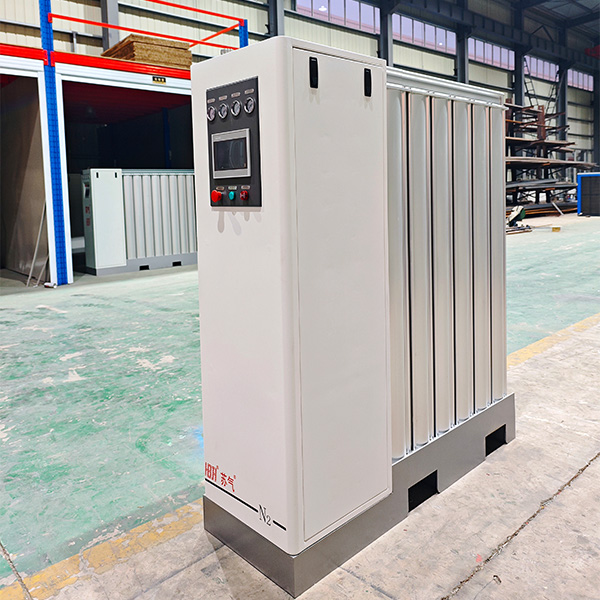
Products / Nitrogen Generator / Membrane Nitrogen Generator
HBFD-MB Series
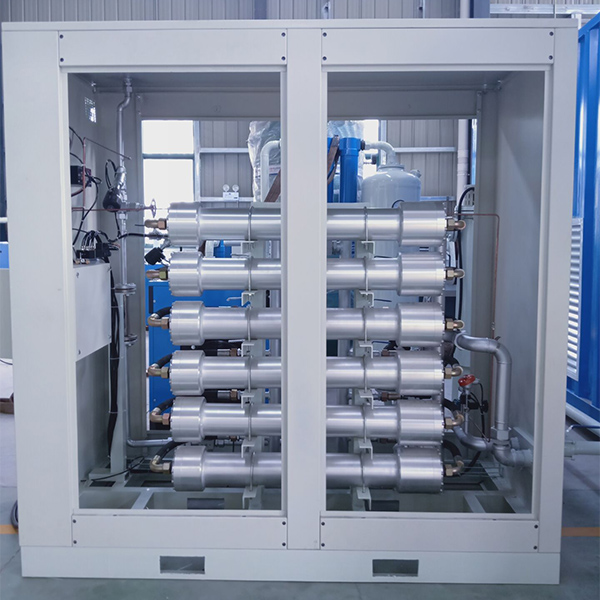
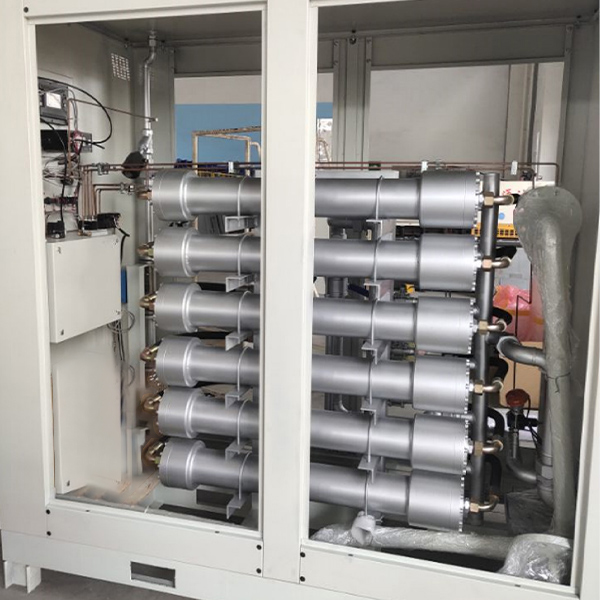
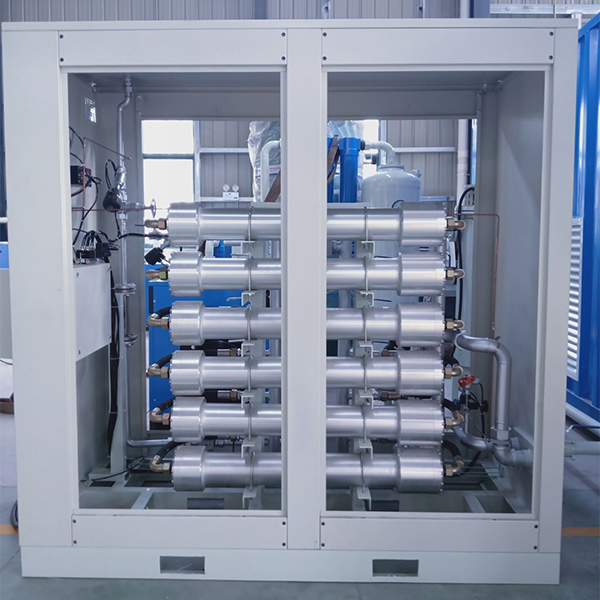
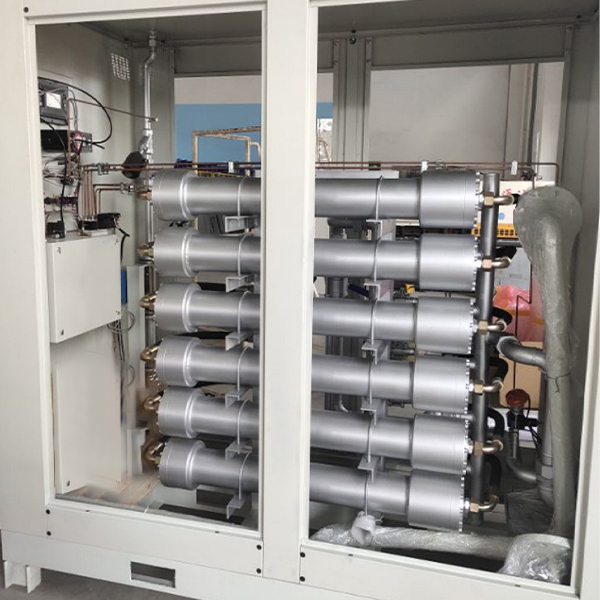
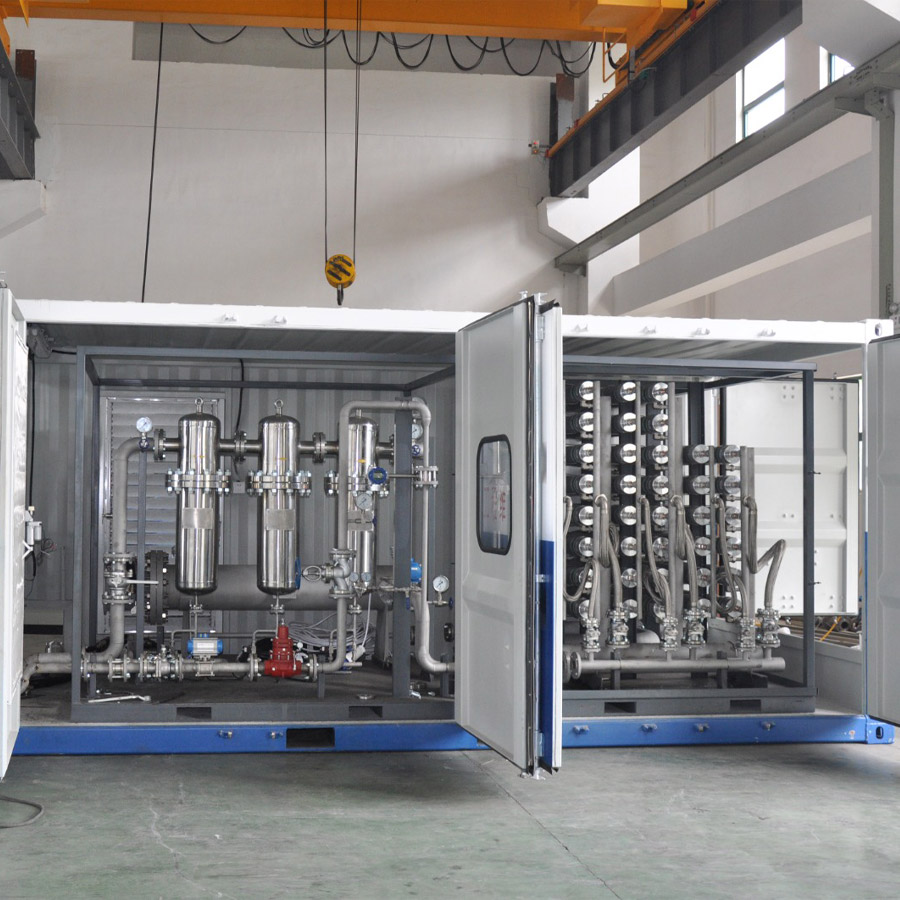
Jiangsu Hongbo's Membrane Nitrogen Generator uses advanced hollow fiber membrane separation technology to produce high-purity nitrogen (90%-99.5%) from compressed air. With a simple static design, minimal moving parts, plug-and-play operation, and low maintenance requirements, it delivers stable, clean, low-dew-point nitrogen for food packaging, chemical inerting, pharmaceutical processing, and industrial purging. Models range from 15 Nm³/h to 2000 Nm³/h with scalable capacity and energy-efficient performance.
Overall, the membrane separation nitrogen generation system provides enterprises with a "low-cost, low operation and maintenance, high stability, high flexibility" nitrogen generation solution:
| Model (Nm³/h) | Gas Production (Nm³/min) | Air Consumption (mm) | Import DN (mm) | Export DN (mm) |
|---|---|---|---|---|
| HBFM95-50 | 50 | 2.1 | 32 | 25 |
| HBFM95-60 | 60 | 2.5 | 32 | 25 |
| HBFM95-70 | 70 | 2.9 | 32 | 25 |
| HBFM95-80 | 80 | 3.4 | 40 | 25 |
| HBFM95-100 | 100 | 4.2 | 40 | 25 |
| HBFM95-120 | 120 | 5.1 | 40 | 32 |
| HBFM95-150 | 150 | 6.3 | 50 | 32 |
| HBFM95-180 | 180 | 7.6 | 50 | 40 |
| HBFM95-200 | 200 | 8.5 | 50 | 40 |
| HBFM95-300 | 300 | 12.7 | 65 | 40 |
| HBFM95-400 | 400 | 17 | 65 | 50 |
| HBFM95-500 | 500 | 20.4 | 80 | 50 |
| HBFM95-600 | 600 | 24.5 | 80 | 50 |
| HBFM95-800 | 800 | 24.5 | 100 | 65 |
| HBFM95-1000 | 1000 | 32.6 | 100 | 65 |
| HBFM95-1200 | 1200 | 40.8 | 100 | 80 |
| HBFM95-1500 | 1500 | 61.2 | 125 | 80 |
| HBFM95-2000 | 2000 | 81.6 | 150 | 100 |
| Model (Nm³/h) | Gas Production (Nm³/min) | Air Consumption (mm) | Import DN (mm) | Export DN (mm) |
|---|---|---|---|---|
| HBFM99-15 | 15 | 1.2 | 25 | 25 |
| HBFM99-20 | 20 | 1.6 | 25 | 25 |
| HBFM99-25 | 25 | 2 | 32 | 25 |
| HBFM99-30 | 30 | 2.4 | 32 | 25 |
| HBFM99-50 | 50 | 4 | 40 | 25 |
| HBFM99-60 | 60 | 4.8 | 40 | 25 |
| HBFM99-80 | 80 | 6.4 | 50 | 25 |
| HBFM99-100 | 100 | 8 | 50 | 25 |
| HBFM99-150 | 150 | 12 | 50 | 32 |
| HBFM99-180 | 180 | 14.4 | 65 | 40 |
| HBFM99-200 | 200 | 16 | 65 | 40 |
| HBFM99-250 | 250 | 20 | 65 | 40 |
| HBFM99-300 | 300 | 24 | 80 | 40 |
| HBFM99-350 | 350 | 28 | 80 | 40 |
| HBFM99-400 | 400 | 32 | 100 | 50 |
| HBFM99-450 | 450 | 36 | 100 | 50 |
| HBFM99-500 | 500 | 40 | 100 | 50 |
| HBFM99-600 | 600 | 48 | 100 | 50 |
| HBFM99-800 | 800 | 64 | 150 | 65 |
| HBFM99-1000 | 1000 | 80 | 150 | 65 |
| HBFM99-1200 | 1200 | 96 | 150 | 80 |
| HBFM99-1500 | 1500 | 120 | 200 | 80 |
| HBFM99-2000 | 2000 | 160 | 250 | 100 |
Note: The above data is based on 0.8 MPa(G) feed air, ambient temperature 20°C, 0 m elevation and 80%% relative humidity as design basis.
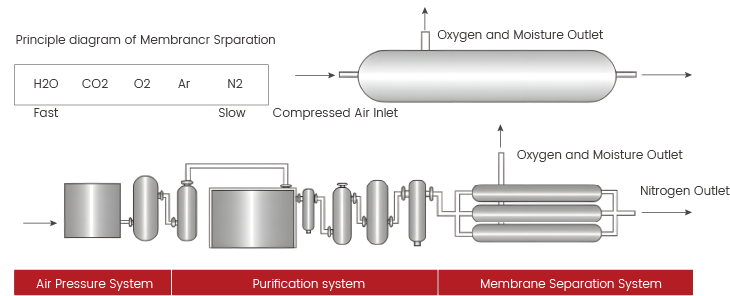
The core principle of the membrane separation nitrogen generation system is to achieve air separation by utilizing the difference in permeation rates of different gas molecules in polymer membrane materials. When pre-treated compressed air enters the membrane module, "fast gas" molecules such as oxygen, carbon dioxide, and water vapor quickly permeate through the membrane wall and are discharged, while "slow gas" molecules such as nitrogen are enriched on the other side of the membrane module, ultimately forming high-purity product nitrogen. This purely physical separation process requires no phase change or chemical reagents, fundamentally ensuring the system's safety and operational stability.
The polymer separation membrane adopted by the system is a hollow fiber membrane filament prepared through a special process. Each membrane filament has a diameter of only tens of micrometers, but its internal surface area is maximized. A single membrane module can integrate millions of membrane filaments to form a large gas separation interface. This structural design greatly increases the contact area between air and the membrane, not only ensuring the nitrogen purification efficiency but also enabling the system to achieve considerable nitrogen generation capacity within a limited volume.
The membrane separation nitrogen generation system consists of the following key components connected in sequence:
The system operates automatically and continuously. Pre-treated compressed air enters the membrane module, where oxygen, CO&sub2;, and water vapor permeate through the membrane walls and are vented, while nitrogen is collected as the product gas. The entire process is continuous, with no valve switching required, ensuring smooth and reliable nitrogen supply.
Compared with traditional cryogenic air separation and pressure swing adsorption (PSA) nitrogen generation, the membrane separation nitrogen generation system has a simpler structure. The entire system consists of an air compressor, a pre-treatment system (filter, dryer), a membrane separation module, a nitrogen buffer tank, and a control system, without complex valve switching mechanisms or low-temperature refrigeration units. This design significantly shortens the system's installation and commissioning cycle. Enterprises do not need to equip a professional operation and maintenance team; only regular equipment inspections are required to ensure stable operation. The full life-cycle cost from equipment procurement, installation to daily maintenance is significantly lower than that of similar products.
For small and medium-sized enterprises or scenarios with scattered nitrogen demand, the "plug-and-play" feature of the membrane separation nitrogen generation system is particularly convenient. It only needs to be connected to a compressed air source and set the required nitrogen purity and pressure parameters. The system can operate automatically and continuously produce qualified nitrogen, avoiding problems such as site occupation and leakage risks of liquid nitrogen storage tanks, allowing enterprises to focus more energy on core production links.
The core component of the membrane separation nitrogen generation system—the membrane separation unit—is a static device without moving parts such as frequently starting and stopping valves and compressors, which fundamentally reduces equipment failure points. Although the pre-treatment unit of the system includes components such as filters and dryers, the replacement cycle of related consumables (such as filter elements and adsorbents) is generally more than several thousand hours, and the replacement operation is simple and convenient, which can be completed without professional tools.
According to third-party test data, the mean time between failures (MTBF) of high-quality membrane separation nitrogen generation systems can reach more than 8,000 hours, and the annual maintenance time is less than 20 hours, reducing the operation and maintenance workload by about 60%% compared with PSA nitrogen generation systems. This advantage is crucial for continuous production enterprises, which can effectively avoid production line shutdowns caused by equipment failures and ensure the smooth progress of production plans.
The nitrogen purity of the membrane separation nitrogen generation system can be flexibly adjusted within the range of 90%%-99.5%%, and the purity fluctuation range does not exceed ±0.2%%, which can stably match the needs of different scenarios such as modified atmosphere preservation in the food industry (requiring more than 98%% purity) and pipeline purging in the chemical industry (requiring more than 95%% purity).
The nitrogen produced by the system not only has stable purity but also has the characteristics of "low dew point and low impurities". After deep drying and filtration by the pre-treatment unit, the dew point of nitrogen can reach below -40°C (some high-end models can reach -60°C), the oil content is less than 0.01 mg/m³, and the particle content is less than 0.1 μm, which fully meets the harsh requirements for gas cleanliness in industries such as food packaging and chemical engineering.
The nitrogen generation capacity of the membrane separation nitrogen generation system has good scalability. When the enterprise's nitrogen demand increases, there is no need to replace the entire system. The production capacity can be increased only by adding the number of membrane modules or paralleling new membrane separation units. This "on-demand expansion" feature allows enterprises to gradually increase equipment investment according to their own development rhythm, avoiding the capital pressure caused by one-time purchase of large-scale equipment.
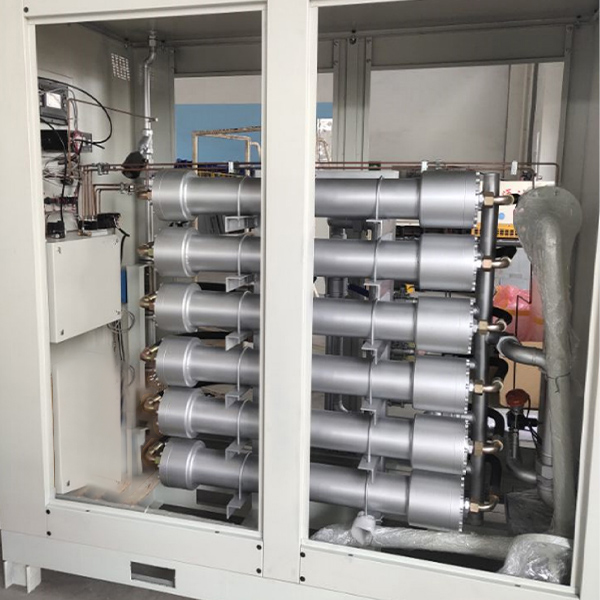
With its significant advantages, the membrane separation nitrogen generation system has been widely used in multiple industries:
| Industry | Application |
|---|---|
Food Industry |
Used for modified atmosphere preservation and packaging filling of food, extending the shelf life of food and maintaining the taste and nutrition of food. |
| Chemical Industry | Used for pipeline purging, tank inerting, and material transportation protection, avoiding dangers caused by contact between flammable and explosive materials and air. |
| Pharmaceutical Industry | Used for aseptic filling and freeze-drying protection of medicines, ensuring the quality and safety of medicines. |
| Electronics Industry | Used for component soldering, reflow oven inerting, and storage cabinet protection to prevent oxidation of sensitive electronic components. |
| Metal Processing | Used for annealing furnace atmosphere protection, laser cutting gas supply, and heat treatment inerting to improve product surface quality. |
Contact us for detailed product specifications and customized solutions.
Contact Us